Before the destruction of the first and second Beit Mikdash, which was the center of worship for Jews during the first and second temple period, the Jewish people only knew how to follow Halacha (Jewish Law) according to what was written in the Torah. However, since the destruction of the second Beit Mikdash and the adaptations that were made in order for Judaism to continue on, a new kind of Jewish Law was developed: the Torah shebaal peh, or oral law. Both the written law and the oral law contain positive as well as negative aspects, which means the people of the modern Reform movement should take into consideration both types of law when deciding how to follow Halacha because, although they are different, they are both equally important.
In comparison to any kind of oral law, written law is more set in stone which diminishes the ability to change it. This aspect of the written law can be viewed in both a positive and a negative perspective; some may say that the law should never be changed anyways, but others may say that the law must be changed in order for it to apply to modern day society. A beneficial aspect of the written law includes that fact that questions such as, "who was there?" and, "what happened?" are easily answered by simply looking back in the Torah. Another positive facet of written law is that it was "Halacha l'Moshe m'Sinai" or "the law given to Moses at Sinai" which means that it is considered the law that God gave to the Jewish people to follow. On the other hand, because written law can't be changed or adapted, the rules that we are required to follow as Am Yisrael (the Jewish people) are harder to obey due to the dramatic societal changes that occur between time periods. The Reform movement should definitely consider what is required in written law because it supposedly contains what God commanded on the day Moses stood on top of Mount Sinai to receive the Torah. We, as the people of Reform Judaism, cannot just throw away what our religion is solely based on. However, following exactly what the written law tells us to do may be slightly more difficult than what the oral law tells us to do.
While written law is more set in stone, oral law has the ability to be changed, leaving room for interpretation as well as modernization. In other words, oral law is slightly more controversial under the circumstances that people were better able to bend and twist its interpretation whether it was by accident or on purpose. Late in the first century, Rabbi Akiva adopted the responsibility of organizing the newly formed oral law into six books; this strategy made it easier for the Jews to find a specific law that they were looking for when trying to determine how to follow it. Then around 200CE, Yehudah HaNasi finalized Rabbi Akiva's organization and wrote down the oral law into what we know as the Mishnah. About 300 years later, a man named Rav Ashi wrote the Babylonian Talmud, which is a combination of the Mishnah and the Gmarah (commentary on the Mishnah). The Talmud is used by Am Israel to discuss Halacha and interpret what it means and what we need to do in order to follow it. For example, in the Torah it says that God told Moses, "Do not boil a child in its mother's milk." One way to interpret this statement is to believe that keeping Kosher only involves not mixing red meat with dairy, but not necessarily to not mix all meat and dairy. However, the topic of keeping Kosher can be interpreted in many different ways. Of course there are other stories included in the Torah that talk about different rules of keeping Kosher, such as those that relate to eating pork and shellfish, but even those stories can be interpreted in several ways. From a positive, and especially a Reform perspective, its considered a good thing that halacha can be interpreted in multiple ways because all people are able to take what they personally think is important out of the oral law and follow it the way they see is best fit for themselves, while still keeping Jewish tradition. In contrast to this positive look on oral law, others, such as Orthodox or maybe even Conservative Jews, may find it a very negative aspect that it is able to be interpreted in several ways because if everyone is following one law in hundreds of different ways, how can we, the Jewish people, define ourselves as one religion, one nation? The flexibility itself contains both the positives as well as the negatives of oral law.
One day in Jewish History class, we were discussing whether or not interpreting and modernizing Halacha is okay to do. Personally, I believe that as long as we, the Reform Jews, don't drift too far from the law given to Moses at Sinai, or what is written in the Torah, then we should be adapting Halacha in order for us to keep tradition while also making it easy to live in modern-day society. Reform Judaism is all about allowing people to be Jewish in the way that they see is best fit for them, without forgetting where we came from. Besides the fact that there are several varying streams of Judaism, we are all still one people, one religion, one nation. Whether or not we agree or disagree about the modernization of Halacha is not nearly as important as recognizing the fact that we all believe that, as Jews, our goal is to better the world and help those in need. Therefore, if the Reform movement decides that we can better follow Halacha if we adapt it to the society in which we all live, then why shouldn't we do exactly that? After all, without reforming the Jewish Law, how can we consider ourselves "Reform" Jews?
Thursday, March 24, 2016

Wednesday, March 16, 2016
History in America vs. History in Israel
Throughout the entire semester, our Jewish History teachers have been emphasizing how everything we learn in class can be seen through the remains of the events that occurred all over Israel. Yesterday, we visited the crusader fortress where the Ashkenazi Jews had been persecuted. While I was sitting inside of one of the many well-preserved, stone rooms I realized that what our Jewish History teachers had been emphasizing was 110% true. At home, when we learn about American History, we don't necessarily feel the connection to what took place simply because we rarely get the chance to see where it happened and what's left from it. For example, when we learned about the American Revolution, we never got to visit Yorktown where the final battle took place. Or when we were learning about the Civil War, we never had a chance to visit the Southern states to see where we fought the Confederates. But in Israel, every time we learn about a major event that took place and influenced Judaism and Am Yisrael (the people of Israel) we go to the place in which that specific event occurred. Of course I realize that Israel is probably a hundred times smaller than the United States, so that definitely has an effect on why we can't travel to every place where some part of the history of America happened. But here in Israel, it's actually the coolest thing ever that we get to go to every preserved site where something super important and influential happened. In the beginning of the semester, I didn't really understand why our Jewish History teachers tried so hard to emphasize that everything we learn about can be proven through the remnants of each event, but now I realize that we are so lucky to be able to see exactly that.
Sunday, March 13, 2016
Men Who Bake Challah (Jewish History Blog Assignment)
Before reading this article, I never would have guessed that baking challah was a gendered act in Judaism. I can't say it doesn't make sense, because women used to be associated with domestic tasks such as cooking and cleaning (and, unfortunately, still are in some cultures/religions). But assuming that baking challah is a job that can only be done by women is just plain silly, at least in my opinion. And apparently I share that opinion with several other Jewish men. According to the article, "challah baking has become increasingly popular among Jewish men." They even consider it a way of honoring Shabbat- liking how it impresses Shabbat guests and enjoying the intimate feeling it brings when using a family recipe. While it's recognizable that challah baking is associated with femininity, its gendered heritage is unclear especially when compared to traditions such as lighting the candles and immersing in the mikveh (ritual bath)- both of which have stronger female identities.
I have yet to decide whether this article makes me feel better or worse about gender equality within Judaism. While it's great news that a previously considered feminine act has now become so popular among men, its also kind of dumb (for lack of a better word) to even gender an act such as baking challah. But that's just how I'm looking at the situation...I guess I was just surprised at the fact that such a simple task was labeled as "feminine." However, it's mind-easing to know that it is increasing in popularity among men. This proves that labeling tasks as "masculine" or "feminine" is pointless because, in future societies, the gender that the task was previously associated with may change. I can't say that I care a lot about this for the sole reason that Reform Judaism does not associate any acts with the male or female gender, but men baking challah could reveal to Orthodox Jews that gendered tasks, in reality, are unisex.
http://www.tabletmag.com/jewish-life-and-religion/198163/challah-and-the-men-who-bake-it
I have yet to decide whether this article makes me feel better or worse about gender equality within Judaism. While it's great news that a previously considered feminine act has now become so popular among men, its also kind of dumb (for lack of a better word) to even gender an act such as baking challah. But that's just how I'm looking at the situation...I guess I was just surprised at the fact that such a simple task was labeled as "feminine." However, it's mind-easing to know that it is increasing in popularity among men. This proves that labeling tasks as "masculine" or "feminine" is pointless because, in future societies, the gender that the task was previously associated with may change. I can't say that I care a lot about this for the sole reason that Reform Judaism does not associate any acts with the male or female gender, but men baking challah could reveal to Orthodox Jews that gendered tasks, in reality, are unisex.
http://www.tabletmag.com/jewish-life-and-religion/198163/challah-and-the-men-who-bake-it
Tuesday, March 8, 2016
To Keep Kosher or to Not Keep Kosher
This question is one that I have considered before, but pre-EIE I have always ended up answering this question with a "no way I LOVE cheeseburgers, AND bacon, AND shellfish." Now, though, while I am forced to keep kosher here in Israel and am learning about the specific laws in Jewish History class, I have been exposed to a new perspective on keeping kosher. Today in class we learned about how, in the Torah, God speaks to Moses and says "do not boil a kid in its mother's milk" and Moses is left to interpret it in the way he thinks is right. But today, according to Oral Law, the rules of keeping kosher seem to be a lot more strict. When I hear the word "kosher" I immediately think about dairy and meat and how they are not meant to be eaten together at all, along with not eating shellfish and pork. However, in class we discussed how the rules of keeping kosher can be interpreted in many ways (surprise, surprise) which is similar to just about every other law that is written in the Torah. It was interesting to hear everyone's separate opinions on what it means to keep kosher, and it has truly opened my mind up to whether or not I would remain eating kosher even after I arrive home in America.
With this thought in mind, I would have to consider many things. For instance, would I strictly separate dairy meals from meat meals like I do here? Or would I go by the literal meaning "do not boil a kid in its mother's milk" and simply not mix red meat with dairy? Also, would I be able to keep myself from eating bacon? Maybe so...there's always turkey bacon as an alternative (but we all know that it doesn't taste as great). Another decision I would have to make is whether or not I would eat shellfish ever again, which keep in mind, is one of my FAVORITE foods. Basically, I have a lot to think about: is my Jewish identity worth sacrificing delicious food for? Does keeping kosher really matter all that much to me? I personally believe that following a few certain Jewish laws as a Reform Jew is not so important. On the other hand, how can I define as Jewish if I don't do what is traditionally practiced? There are a lot of unclear answers to a lot of big questions involving Judaism, and the interpretation of keeping kosher is definitely among them.
Sunday, March 6, 2016
The Voice of an Arab-Israeli Doctor (Jewish History Blog Assignment)
Faiza, and Arab-Israeli doctor, lives in an Arab neighborhood in Jerusalem called Shuafat and is the head of the intensive care unit at a private hospital in Israel. She has an immense love for Israel and claims that it "gives you the opportunity to express your human potential." Throughout the article Faiza talks about how happy she is with her life here in Israel, specifically being able to witness the risks that Israeli soldiers take in order to care for Syrians and get them to a hospital safely. She also mentions that whenever she goes home to meet with her family, she has to remain quiet and resist from defending Israel in front of her brothers and their families to prevent putting her own children in a risky situation. However, Faiza's Arab brothers do not prevent her from feeling the joy she receives from her life in Israel.
It's incredible to read something so optimistic about a topic that isn't exactly filled with positivity. Faiza emphasizes the coexistence that is present in Israel throughout this article and how thankful she is for that. Her exact words being, "here Arab people are the happiest Arabs in the Middle East" and while many people may disagree with that statement, her opinion is one that brings optimism to people all over Israel. Living here for a little over a month now (although it feels like I've been here for years) allows me to relate to this feeling that Faiza has shared. I feel 100% at home here in Israel, and knowing that a vast diversity of people are happy living here as well is nice to think about due to the many tragedies that have taken place because of how isolated some parts of the country are from this feeling of acceptance and coexistence among us.
If you'd like to read the article itself, you can find it through this link and I hope it will put as big a smile on your face as mine.
http://blogs.timesofisrael.com/what-israel-is-giving-me-the-voice-of-an-arab-doctor/
It's incredible to read something so optimistic about a topic that isn't exactly filled with positivity. Faiza emphasizes the coexistence that is present in Israel throughout this article and how thankful she is for that. Her exact words being, "here Arab people are the happiest Arabs in the Middle East" and while many people may disagree with that statement, her opinion is one that brings optimism to people all over Israel. Living here for a little over a month now (although it feels like I've been here for years) allows me to relate to this feeling that Faiza has shared. I feel 100% at home here in Israel, and knowing that a vast diversity of people are happy living here as well is nice to think about due to the many tragedies that have taken place because of how isolated some parts of the country are from this feeling of acceptance and coexistence among us.
If you'd like to read the article itself, you can find it through this link and I hope it will put as big a smile on your face as mine.
http://blogs.timesofisrael.com/what-israel-is-giving-me-the-voice-of-an-arab-doctor/
Monday, February 29, 2016
A Week Jam-packed with Adventures

Yulie, me, Amber

Yulie, me, Amber

me, Amber, Yulie

Max and me


me, Amber, Yulie, Tamar

(Noam lol) me, Amber, Yulie

Dani, Max, me, Tamar

Tamar and me

Sunrise at Masada

Sam, me, Tamar, Nathan

Ali, me, Dani, Yulie, Joely


Yulie, Tamar, me
Religious Coexistence in Iraq (Jewish History Blog Assignment)
With all the current ongoing wars in the Middle East, it's hard to believe that there can or will be any coexistence among the several different religious countries. However, a Jewish shrine of the Prophet Ezra still stands in Iraq today. The tomb is in a town called Uzair, Ezra is Arabic, and contains many Jewish symbols and Hebrew writing. Although this tomb was built by Jews, it became an "Islamic landmark following the mass exodus of the Jews of Iraq to Israel in the 1950s" (Zeed). Through the varying religious aspects that are found on this shrine, it is considered a symbol of harmony between Judaism and Islam. Iraqi journalist, Abdulhadi Mhoder, said that this symbol "reflects religious tolerance and confessional coexistence in Iraq." While a few of the Jewish symbols have been removed from the tomb and replaced with Islamic verses, it is also important to recognize the remaining Jewish symbols and Hebrew writing. A member of the Maysan provincial council also said that "The people of the city welcome Jewish visitors to this shrine, although it was transformed into an Islamic landmark." An optimistic thought for sure.
The fact that the country of Iraq has an Islamic-Judaic shrine as a tourist site that welcomes all people reveals that coexistence and peace across the Middle East is achievable. While it seems impossible now due to the intense and seemingly never-ending wars that are currently consuming all of the media's attention, this tomb gives hope that maybe one day everyone may live in harmony with each other. As unrealistic and cheesy as it sounds, the idea is tangible as long as little proofs of coexistence remain and increase. Who knows? Maybe 50 years from now I will go back to read this blog post and reminisce about the times where the world was so strange and wonder why this tragic violence ever existed in the first place. One can only hope.
The fact that the country of Iraq has an Islamic-Judaic shrine as a tourist site that welcomes all people reveals that coexistence and peace across the Middle East is achievable. While it seems impossible now due to the intense and seemingly never-ending wars that are currently consuming all of the media's attention, this tomb gives hope that maybe one day everyone may live in harmony with each other. As unrealistic and cheesy as it sounds, the idea is tangible as long as little proofs of coexistence remain and increase. Who knows? Maybe 50 years from now I will go back to read this blog post and reminisce about the times where the world was so strange and wonder why this tragic violence ever existed in the first place. One can only hope.
Sunday, February 28, 2016
A Once in a Lifetime Experience Within a Once in a Lifetime Experience
The past 10 days = a rollercoaster. A very long, exciting, and dreadful rollercoaster. Last Wednesday, we all packed up our things and officially, although temporarily, moved out of Kibbutz Tzuba. Our first stop on our rollercoaster of a week was the Masada Youth Hostile where we spent the first half of the night sleeping (until about 4am) and the second half of the night and most of the morning hiking 900ft to the top of Mt. Masada. Rather than explaining the experience, let me just say that it looked and felt like someone dumped a gallon of water on me, and my roommates and I spent the entire hike down arguing over who got to shower first. The next day, we journeyed through paths interrupted by springs that varied in depth from our ankles to our bellybuttons. Our destination was quite the surprise: a glorious waterfall that cascaded down into a large pool of fresh water. It only took about ten seconds for us to strip down to our bathing suits and run straight underneath the waterfall. I must admit that this experience was the first that was purely fun, meaning there was no Jewish History to learn while we were swimming in the refreshing natural pool. Let me tell you that these two days were absolute heaven compared to what lied ahead of us in the next five days.
Gadna was.....well, it was Gadna. Imagine the dirtiest bathroom you can and multiply that by eternity and that MIGHT come close to the disgustingness of the bathrooms we were forced to bear with. Now imagine the worst food you have ever eaten and multiply that one by eternity, too. I promise that the food at Gadna was worse. However, not every single aspect of those five days was completely terrible. The one part of Gadna that I will never forget was, unsurprisingly, shooting the gun. Before I even left for EIE, one of the things I was most excited for was to experience what it is like to be in the I.D.F. and to learn how to use the weapon that every Israeli uses to defend their country. After all, this event was a once in a lifetime experience within my once in a lifetime experience. When the five teams of EIE arrived at the shooting range, everyone began to either jitter with excitement or overflow with anxiety. Personally, I was a mixture of both. I was surprised at my own reaction because I was nothing but excited before the day came, but I guess the reality of it all finally hit me and resulted in my worry. I distinctly remember the feeling of butterflies in my stomach and the lump in my throat before we, the very first group to shoot, entered the small 3-wall building where the actual shooting took place. How vivid the memory in my mind is when the instructor told us to put on our headphones to protect our ears from becoming deaf and the sudden silence that I was consumed by. It was just me and the gun at that point, or so it felt. In reality, there were 11 other girls in the little shack-like building with me probably feeling the same way I was, but all I could focus on was getting the little tip of my scope directly on the center of my target. After all the other detailed instructions were told, and the commander shouted "ESH!" (fire in Hebrew) I suddenly froze, my finger steady on the trigger. I didn't want to be the first one to shoot. What felt like ten years, but was really only about 2 seconds later, I heard the first bullet shot and I reacted by pulling my own trigger. The first bullet escaped from my gun and in the literal blink of an eye, it was gone. I had no way of telling if it had hit the target or the giant mountain of sand behind it, but I didn't care so much. The burst of adrenaline that had shot through my entire body was my only focus at that point. Quickly, but not too quickly, I shot the other four bullets. The feeling was exciting and nerve-wracking all the same. It was most definitely the highlight of my week at Gadna. Experiencing this once in a lifetime opportunity really opened my eyes to how powerful a gun is. While others did not enjoy the experience as much, for some reasons that are different than others, I enjoyed it simply because it was pure excitement and gave me a feeling of honor and respect toward soldiers around the world. The way Israelis view a gun is so incredibly different from the way Americans view a gun. Defense vs. attack. Help vs. harm. Purity vs. destruction. It's tragic to see the many deaths that guns have caused in America, especially in more recent years, but it was rewarding to gain a new perspective on the weapon and learn to respect it rather than despise it. This lesson, and this great opportunity is one that I will never forget.
Sunday, February 14, 2016
NFTY vs. EIE: Shabbat Edition
Throughout these last few weeks, I have noticed several similarities and differences between my experiences at NFTY-NE events and my experiences here in Israel. For example, at NFTY events and here on EIE, upbeat melodies to prayers are included in our interactive services. Also, each and every service is led by the participants themselves, making it very enjoyable and relatable. However, there are also small differences between the two, such as dressing up only for Kabbalat Shabbat and evening services at NFTY events, while we dress nice for the entire weekend here on EIE. On Friday morning, everyone left the Kibbutz for Tzedekah: some people went to take care of homeless cats while two other groups (one in which I was a part of) went to nursing homes to cheer up the elderly by singing them some familiar and unfamiliar songs. This part of the day, although it was heartwarming to see the smiles we brought to some faces, was a bit of a challenge considering I know very little Hebrew which prevented me from having conversations with any of the members. After we returned, we all had a few hours of free time and then we prepared for evening services. The madrichim (counselors) divided those who stayed on the Kibbutz for the weekend into two groups, each group going to a different temple that night. For me, this was an experience that I will never forget; my group had gone to a different Kibbutz that also had a farm......let's just say my nose will never forget this service. In spite of the unusual scents that my friends and I experienced while walking to and from the bus, the service itself was small and cozy which made it more intimate than any other service I have participated in.
However, the most eye-opening part of my weekend was definitely Saturday morning services. When services first started, I wasn't sure how great they would be considering the small amount of time the T'fillah Committee had to prepare. But to my surprise, it may have been one of the most relatable and meaningful services that I have ever been a part of. Surrounded by my new, yet very very close friends, singing familiar NFTY tunes to the prayers, and watching those who mean so much to me succeed in chanting Torah was inspiring to say the least. I realized during this service how proud I was of all the people that had the confidence to lead us in prayer, to read from the Torah, and to deliver the D'var Torah. I realized during this service that even though I am more than 5,000 miles away from home, I have made my own home out of this community.
Tuesday, February 9, 2016
Anti-Israel Billboards in Orlando (Jewish History Blog Assignment)
A teen in Orlando has recently brought up an issue that strikes me as unsurprising, yet disappointing all the same. Apparently there have been several billboards displayed in the Orlando area promoting anti-Israel ideology over the last few months. The billboard campaign's goal is to convince people that Palestinian justice must be achieved. Local activists have displayed these billboards in order to provoke questions about the American-Israeli alliance, or so it seems. The reality of the purpose of these billboards is not to question whether America should be supporting Israel during these difficult times, rather it is to convince people that Israel should be eliminated as a state. Not only does the organization, "Boycott, Divestment and Sanctions" run this anti-semitic billboard campaign to emphasize their opinion on the Israeli-Palestinian conflict, but they aim "to violate the Jewish people's right to self-determination in their ancestral home" as well.
It's nearly heartbreaking to realize how determined some organizations are to break down a group of people, or an entire country for that matter. The fact that these anti-Israeli advertisements were permitted to be displayed along highways in a major well-known city makes me wonder if there is any hope in the world for peace. When a person who does not have any prior knowledge on the topic of the Israeli-Palestinian conflict see these biased billboards, the anti-Israel/pro-Palestinian ideas are then planted in their mind and may influence that person to believe what the advertisements are promoting when the truth is that they don't have all the facts and information in order to take a standpoint on the matter. On the other hand, a pro-Palestinian most definitely favors these billboards making a statement in a popular city, which makes the entire situation very controversial. Should these billboards be permitted in American cities when America is an ally of Israel? Should an organization like "Boycott, Divestment and Sanctions" be allowed to persuade people into developing a pro-Palestinian opinion on the issue? The answers to these questions seem like they would be straight forward, but they are actually anything but obvious. As a Jew, I of course disagree with the allowance of anti-Israel advertisements, but I am only one person among billions of other people. Nonetheless, it is still extremely disappointing to realize that some people feel so strongly toward such a controversial situation that they feel the need to hammer down on one side, without considering the effects that it has on the other. Maybe we will see a positive change in the near future, but one can only hope.
It's nearly heartbreaking to realize how determined some organizations are to break down a group of people, or an entire country for that matter. The fact that these anti-Israeli advertisements were permitted to be displayed along highways in a major well-known city makes me wonder if there is any hope in the world for peace. When a person who does not have any prior knowledge on the topic of the Israeli-Palestinian conflict see these biased billboards, the anti-Israel/pro-Palestinian ideas are then planted in their mind and may influence that person to believe what the advertisements are promoting when the truth is that they don't have all the facts and information in order to take a standpoint on the matter. On the other hand, a pro-Palestinian most definitely favors these billboards making a statement in a popular city, which makes the entire situation very controversial. Should these billboards be permitted in American cities when America is an ally of Israel? Should an organization like "Boycott, Divestment and Sanctions" be allowed to persuade people into developing a pro-Palestinian opinion on the issue? The answers to these questions seem like they would be straight forward, but they are actually anything but obvious. As a Jew, I of course disagree with the allowance of anti-Israel advertisements, but I am only one person among billions of other people. Nonetheless, it is still extremely disappointing to realize that some people feel so strongly toward such a controversial situation that they feel the need to hammer down on one side, without considering the effects that it has on the other. Maybe we will see a positive change in the near future, but one can only hope.
Monday, February 8, 2016
שבת שלום!
This past weekend I had my very first Shabbat lunch in Israel with my friends, Tamar and Dani. Shortly after arriving in Tel Aviv at Dani's aunt's apartment, I immediately felt consumed by the Israeli culture. Although we weren't having our Shabbat meal with Dani's family until the next day, her aunt, Nili, had already set the table and most of the food was cooked. The view from her high rise building was breathtaking, especially when the city lit up at night. Not only was our trip a cultural experience, but it was also an easy and fun way to practice my Hebrew. Because Dani's family is fluent in both Hebrew and English (with the exception of her adorable baby cousins who only speak Hebrew), practicing my skills with them was much more enjoyable than learning in a classroom. Her
Savta, which means grandma in Hebrew, made enough food to feed an army (keep in mind that this was the most delicious food I had ever eaten and of course I stuffed myself until I felt like I was going to explode). Leaving Nili's home Saturday evening was a bittersweet departure; I was happy that I had just experienced my first traditional Shabbat meal, but upset because I was leaving such a welcoming home.
Something about the Shabbat meal as a whole made me feel like I was in the presence of my own family, when in reality I was/am half way across the world. It's amazing how such an unfamiliar culture has become a part of my life so quickly and the friends I've made here in Israel already feel like family. I cannot express how grateful I am that there is still more than three months left for me to experience more aspects of the Israeli culture, while strengthening the friendships I have already made, as well as creating new friendships along the way. Hopefully I get to visit Tel Aviv again soon, and learn even more about the exciting traditions that are followed here in Israel.
Savta, which means grandma in Hebrew, made enough food to feed an army (keep in mind that this was the most delicious food I had ever eaten and of course I stuffed myself until I felt like I was going to explode). Leaving Nili's home Saturday evening was a bittersweet departure; I was happy that I had just experienced my first traditional Shabbat meal, but upset because I was leaving such a welcoming home.
Something about the Shabbat meal as a whole made me feel like I was in the presence of my own family, when in reality I was/am half way across the world. It's amazing how such an unfamiliar culture has become a part of my life so quickly and the friends I've made here in Israel already feel like family. I cannot express how grateful I am that there is still more than three months left for me to experience more aspects of the Israeli culture, while strengthening the friendships I have already made, as well as creating new friendships along the way. Hopefully I get to visit Tel Aviv again soon, and learn even more about the exciting traditions that are followed here in Israel.
Thursday, February 4, 2016
Sataf Pictures

Terraces within Sataf


This is the impossible hole that we had to climb through in order to get to the top of the cave, and drop down into in order to get out!!


Amber v'Yulie v'ani (Amber and Yulie and I) :)
Monday, February 1, 2016
LGBTQ Boots Israeli Group from Conference (Jewish History Blog Assignment)
Just a few weeks ago it had been reported that Israeli and American Jews who are a part of an LGBTQ group were uninvited to a conference that was scheduled to be in Chicago, January 20-22. Apparently, the group had been booted due to pressure created by anti-Israeli activists. The A Wider Bridge nonprofit, which creates connections between Israeli and American LGBTQ Jews, was supposed to hold a reception after Shabbat services that Friday evening during the event. However, Arthur Slepian, A Wider Bridge's founder and executive director, was told that their reception was "being cancelled for reasons of safety and security but there was no evidence presented or elaboration on any security issues." Although this reasoning seems plausible due to the tragic shootings and stabbings that have been occurring quite frequently in popular areas of Israel, it is still unreasonable to assume that a reception would be unsafe for the LGBTQ community to attend.
In my opinion, it is ironic that an organization built upon support for minorities is excluding a group of another minority. Fortunately, a petition began on Change.org in order to reverse the LGBTQ Task Force's decision and apologize to the A Wider Bridge Foundation. And guess what....it got nearly 500 signatures within a few hours of being posted! This exclusion of the Israeli gay group was clearly an important issue to a great number of people, bringing a lot of attention to the situation. Even more disrespectful of the National LGBTQ executives was their lack of response to any emails, Facebook posts, and telephone requests. However, being the bigger person in the situation, A Wider Bridge moved their reception to a different hotel a block away from their former location. It is reasonable to say that this altered event will have more attendants than they would have expected before the boot due to people's desire to support equality among the two minorities.
In my opinion, it is ironic that an organization built upon support for minorities is excluding a group of another minority. Fortunately, a petition began on Change.org in order to reverse the LGBTQ Task Force's decision and apologize to the A Wider Bridge Foundation. And guess what....it got nearly 500 signatures within a few hours of being posted! This exclusion of the Israeli gay group was clearly an important issue to a great number of people, bringing a lot of attention to the situation. Even more disrespectful of the National LGBTQ executives was their lack of response to any emails, Facebook posts, and telephone requests. However, being the bigger person in the situation, A Wider Bridge moved their reception to a different hotel a block away from their former location. It is reasonable to say that this altered event will have more attendants than they would have expected before the boot due to people's desire to support equality among the two minorities.
Sunday, January 31, 2016
Tel Tzuba Pictures!!!

My friend Tamar and I in one of the ancient homes on Tel Tzuba


Tamar, Dani, and I under a super cool arc thing


Myself sitting on top of the highest point of the Tel :)


The three of us nestled in the Judean Hills


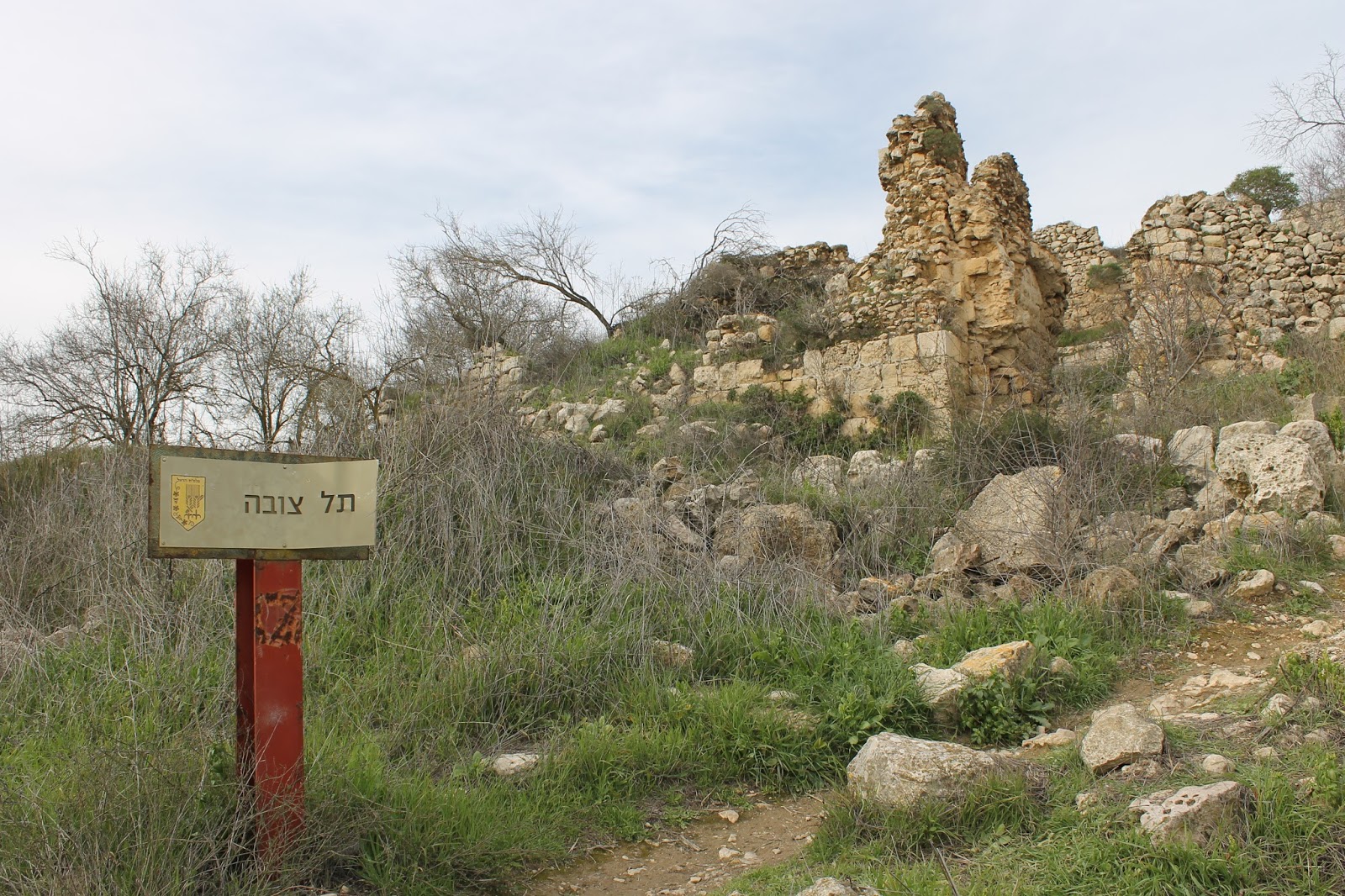
Tel Tzuba in Hebrew
Tel Tzuba
"ARE THOSE CACTI?!" I shouted as my friends and I walked up the Tel. Sure enough, there were dozens and dozens of cacti surrounding the dirt path that lead to our destination. But, unsurprisingly, the cacti were nowhere close to the most beautiful part of our short hike.
At first, I was shocked at how magical the state of Israel looked from even a small hill. As we began our ascent to the top of Tel Tzuba, each and every time I looked out over the peak, chills ran down my spine; each and every time I turned to find something that would make a better picture than the last, I found myself looking at an even more breathtaking view than the one I had seen five minutes before. From afar, the Tel looked somewhat like a turtle-shaped hill. However, once I stood at the highest point possible, on top of a rock wall that had once acted as a home to the indigenous people of Israel thousands of years ago, the Tel had become a place that I could never get tired of. The view that it provides is more glorious than anything I have ever laid my eyes upon in my entire life. A description of this particular view cannot be put in to words, for it would not do it any justice.
Sitting on top of the wall...sitting upon rocks higher up in the sky than I have ever been freely caused a burst of adrenaline to run throughout my body. In the moment that I looked out over the amazingly beautiful cities of Israel I had realized that nothing could compare to the sight that I had very fortunately laid my eyes upon. This moment, this very special moment, was the moment that I fell in love with the country of Israel. And although it is only my sixth day living here, I am already 110% sure that I want to return again soon. Sitting upon the highest point of the Tel had made me a million times more excited to adventure throughout this amazing country. I realized in this moment that I was the luckiest girl alive to be able to travel such a long way from home for such a long amount of time in order to learn and experience Israeli culture, the Jewish people's culture, my people's culture. And with this opportunity, I will make these next four months the best four months of my life.
להתראות
Thursday, January 28, 2016
The Arrival
After surviving the ten and a half hour flight across the Atlantic, we had made it to the Holy Land. Right before landing, each of the forty lucky students who had been able to avoid a delay due to the snowstorm had come upon a beautiful sight. Just around twenty thousand something feet below us was the land of Israel. As we began our descent, the red roofs of Israeli homes and the beautiful mountains and valleys had put me in awe. I had never seen a sight so breathtaking, and then I realized that it was my new home, for the next four months anyway. Once that thought settled in, the adrenaline burst throughout my body. It had FINALLY hit me that I had packed up nearly 100 pounds of clothing and school supplies and taken it half way across the world to start a new chapter of my life in Israel.
As drowsy and disgusting as I felt, I couldn't contain my excitement to finally be in the Ben Gurion airport. Going through the foreign passport line may have been one of the most painful experiences of my life; carrying a backpack that felt like it weighed thousands of pounds and sweating through my shirt and jacket, surrounded by the most diverse group of people I had come to interact with, hearing different languages left and right. Finally, though, the group of forty EIE students made it to baggage claim and we lugged our suitcases on carts through customs and out of the terminal. After exchanging our dollars for shekalim and receiving our new Israeli SIM cards, we were finally on our way to Kibbutz Tzuba.
Since the first day of our arrival to Israel, I feel like I have spent at least a week or two with every person here. The relationships we have developed with each other are already so strong and they will most likely last a lifetime. I can't wait for all the adventures and the memories that we are going to make that we will remember forever.
Subscribe to:
Posts (Atom)